Problem Breakdown
Task Scheduler
Published ·
medium
Try This Problem Yourself
Practice in the AI-enabled editor with real-time feedback
You're given a set of tasks. Each task has a string name, an integer duration, and a list of names it depends on. The Scheduler class already stores them, checks that dependency names are known and that no two tasks directly reference each other in a 2-cycle, and exposes two helpers worth remembering. One helper returns every task that's currently ready to run given a set of completed tasks; call this the ready-task helper. The other returns the earliest moment a given task could start, given a map of when each of its dependencies finished; call this the earliest-start helper. You implement two methods on the Optimizer.
The first method returns a valid linear order (a topological sort of the dependency graph). Every dependency must appear before every task that depends on it. The second method returns a parallel schedule across a fixed number of workers, giving you a total makespan plus a timeline that says when each task runs.
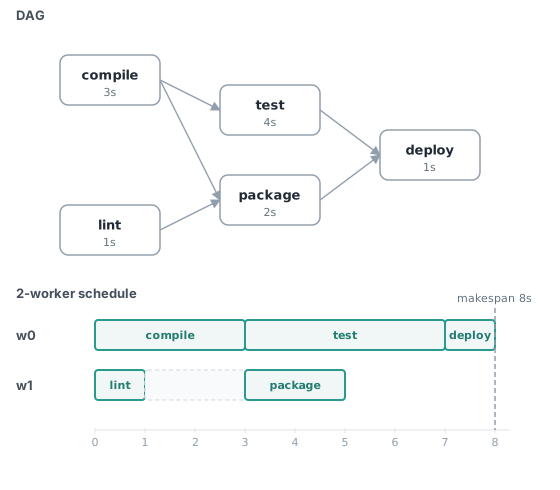
The 5-task dependency DAG with durations on each node, and below it the 2-worker Gantt chart showing the 8-second schedule
The test suite has three graphs. The first two are small and well-behaved. The third is a critical-path graph where five tasks form a long chain that dominates the minimum possible makespan, plus four long-running independent "scans" that look tempting to schedule early but have nothing to do with the chain.
Pattern: Topological Sort
Tasks with prerequisites form a dependency graph, and Kahn's algorithm peels off whatever has no remaining dependencies, one layer at a time. That's topological sort, the backbone of scheduling and build-order problems.
Solution 1, topological sort with Kahn's algorithm
The order question has a standard answer in topological sort. In a dependency graph, a topological order is any sequence where every task comes after all of its dependencies. There are typically many valid orders; you just need one.
Complexity
What this solves, and what it doesn't
Solution 2, fixed-order worker assignment
Complexity
Where it breaks
Solution 3, event-driven simulation
Complexity
Why this wins on the critical-path test
Benchmarks
Takeaways
Purchase Premium to Keep Reading
Unlock this article and so much more with Hello Interview Premium