Problem Breakdown
Nonogram Solver
Published ·
hard
Try This Problem Yourself
Practice in the AI-enabled editor with real-time feedback
You're given a grid with r rows and c columns. For each row and each column you get a clue, which is a list of integers describing the run lengths of consecutive filled cells on that line, in order. A clue like [3, 1] means "a block of three filled cells, at least one empty cell, then a block of one filled cell." The special clue [0] means the line is entirely empty.
Here's a 5x5 whose solution spells out a heart. The left panel is what you receive, showing empty cells with the clues on each axis, while the right panel shows the solved grid.
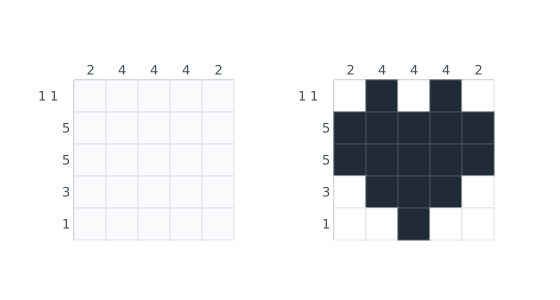
Before and after of a 5x5 heart puzzle, with the empty grid and row and column clues on the left and the solved grid on the right
Row clues run along the left of each grid, column clues along the top. Every filled run in the solution matches its clue from left to right for rows and top to bottom for columns. If no valid filling exists, the solver returns null.
The test suite runs four sizes, starting at 5x5, then 10x10, then 15x15, and finishing with a single 25x25. Each timed test has its own budget, and the wrinkle is that an approach that passes 10x10 can blow the budget on 15x15 by orders of magnitude.
Pattern: Backtracking
You fill the grid by guessing a row, recursing to the next, and backing out when the clues stop lining up. Propagating the forced cells first just trims the search before backtracking takes over.
Solution 1, cell-by-cell backtracking
The most direct way to attack this is backtracking. Walk the cells left-to-right across each row, top row first, then the next row, and so on. At each cell, try FILLED, recurse into the next cell, and if that sub-search fails, try EMPTY instead. When the recursion reaches the bottom-right corner, check whether every row's and every column's runs agree with their clues. If yes, you're done. If no, unwind.
Complexity
Where it breaks
Solution 2, row-by-row backtracking
Complexity
Where it breaks
Solution 3, propagation with search as a fallback
Why this is so much faster than row backtracking
Where it lands
Benchmarks
Takeaways
Purchase Premium to Keep Reading
Unlock this article and so much more with Hello Interview Premium