Course
Deliver: Telling a Good Story
Learn the CARL framework and master the art of delivering compelling, signal-rich stories in behavioral interviews.
Premium video
Sign in & purchase Premium to watch the full video.
You've built your story catalog. You know what questions you might face and which stories map to which signal areas. Now you need to actually tell those stories well.
Our brains love stories. Whether their appeal flows from innate neural structure or whether stories are so ubiquitous they've reshaped that structure, the result is the same: we're hardwired to think in and remember stories. When we hear one, specialized brain regions spring into action, performing mental time travel, triggering empathy, and running simulations of events.
This biological foundation makes stories potent tools for interviews. Unlike a list of accomplishments or abstract descriptions of your skills, stories capture the interviewer's attention and pull them into your experience. Stories slip past critical defenses and activate our brain's dedicated narrative-processing machinery, making them easy to remember long after the interview ends.
This article covers how to structure your stories using a simple framework, which details to include and which to cut, how to handle complex multi-month projects without losing your audience, and how to prepare for the follow-up questions that will definitely come.
The CARL Framework
If you've read anything about behavioral interviews, you've come across the STAR method as a framework for structuring responses:
- Situation: The background and context of the story
- Task: Your specific responsibility or challenge within that situation
- Actions: The concrete steps you took to address the task
- Results: The outcome of your actions
Having a fixed structure like this helps you tell a story with a compelling arc without missing any key pieces interviewers need to evaluate you. An easy-to-remember shorthand like "STAR" makes it possible for you to structure your stories on the fly, with just a little practice in advance.
This isn't a bad method. If you have an interview tomorrow and a bunch of STAR stories prepared, use them. But this format has some drawbacks, especially for senior candidates.
STAR leaves out reflection. There's no explicit place for what you learned from the experience. For senior candidates, this is a way for interviewers to assess your scope. More senior people learn from their mistakes and extract wisdom to be reused on future projects. Without Learnings, you miss an opportunity to demonstrate this.
Situation and Task often blur together. Candidates frequently waste prep time trying to tease apart the two, and in large projects, the distinction between "what was happening" and "what you needed to do" is often artificial anyway.
There is another format that solves these problems, called CARL:
- Context: The overall context of what was happening, including how you were involved. This is the combination of Situation and Task.
- Actions: The concrete steps you took to address the task, what you did, how you did it, and why you chose that approach.
- Results: The outcome of your Actions, what changed, what impact you made on the business.
- Learnings: What you learned or your reflections on the choices you made.
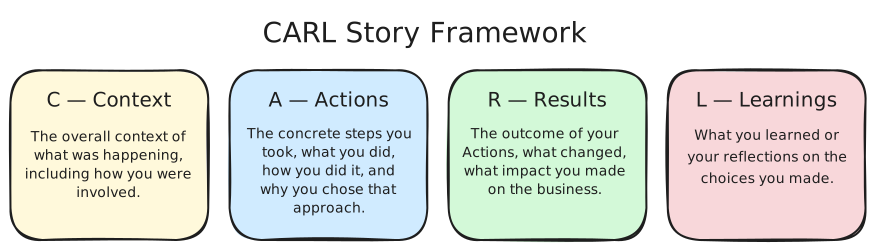
CARL Framework
In CARL, Actions remain the centerpiece, but Context can expand or contract, centering around providing the listener with the minimum amount of setup so they can understand the Actions and their motivations.
Learnings are added as a more natural end of the story. Think of Aesop's fables, where each tale ends with a moral. Learnings provide you a platform for expressing your depth of wisdom, showing that you are self-aware and seek to grow from your experiences.
A Full Story Example
Telling this Story
Context
Context Mistakes to Avoid
Actions
The Value of Detail in Actions
What Actions Should You Include?
Results
When You Don't Have Metrics
Learnings
Adapting to the Question
Adapting to the Audience
Telling Complex Stories
Prepare for Follow-Up Questions
More Story Examples
Example: Junior Engineer: Technical Challenge
Example: Senior Engineer (L5): Cross-Team Project
Example: Staff Engineer: Technical Strategy
Exercise: Develop Your Core Stories
What's Next
Purchase Premium to Keep Reading
Unlock this article and so much more with Hello Interview Premium