
Understanding Job Levels at FAANG Companies
By Evan King
•
Navigating career growth at FAANG companies often involves deciphering a complex labyrinth of jargon and acronyms. For those on the outside looking in, whether you're comparing job offers or trying to understand career progression, the task can be daunting without a comprehensive guide to demystify job levels, salary brackets, and pathways to advancement.
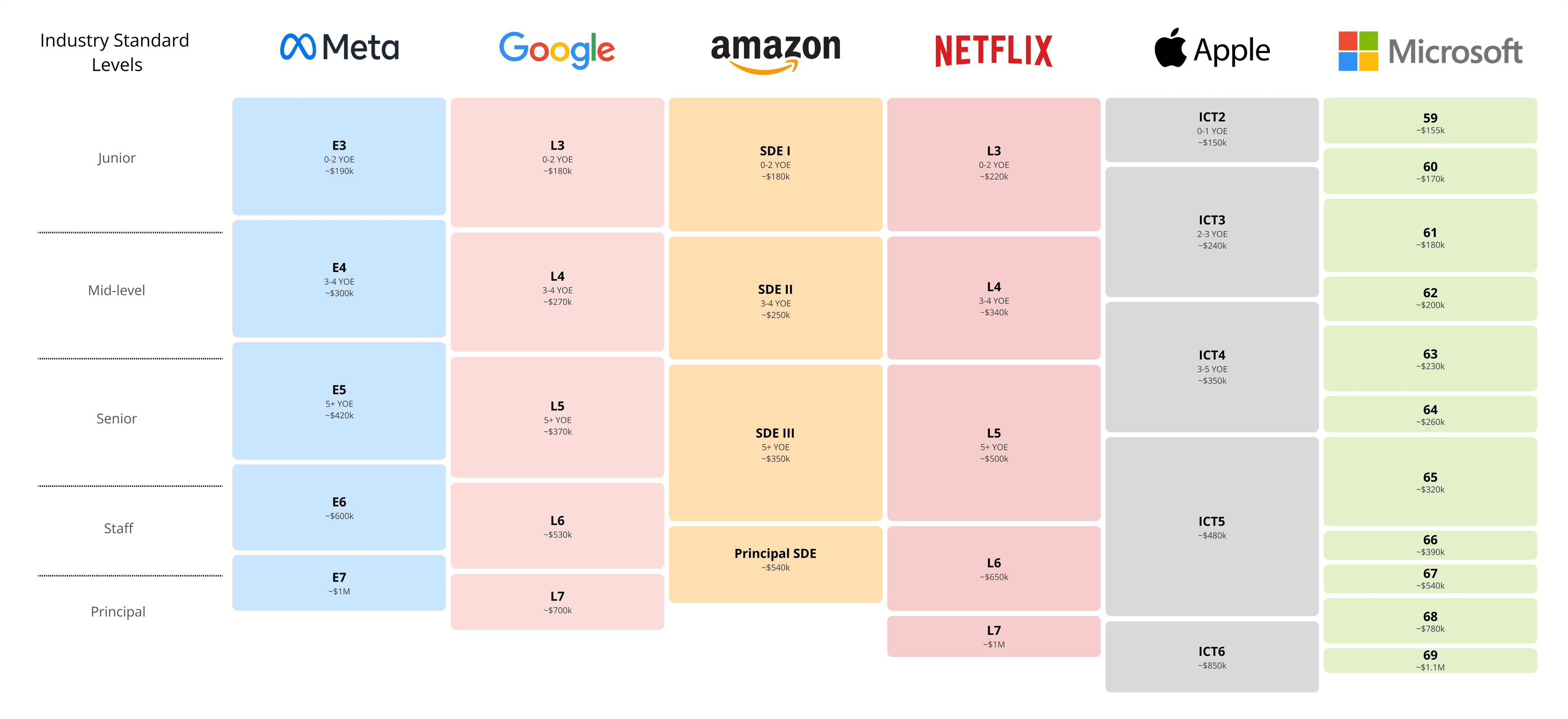
The image below aims to demystify this complexity by providing a streamlined, unified snapshot. For each of the major tech giants—Meta, Google, Amazon, Apple, Netflix, and Microsoft—the chart lays out the corresponding job levels, YoE (Years of Experience), and median salary figures, offering an at-a-glance overview that simplifies comparisons and career planning.
Level Breakdown
Terminology
While the industry standard levels are junior, mid-level, senior, staff, and principal, each company has a different way of referring to each level internally.
At Meta, E(n) stands for Engineer-(n). Junior engineers start at E3 and each subsequent level maps nearly 1:1 with the industry standard terms. The same is true for both Google and Netflix, but instead of E(n) they use L(n) where L stands for Level.
Amazon is fairly straightforward; SDE stands for Software Development Engineer, and their levels increment numerically from SDE I, SDE II, and SDE III, before switching to Principal SDE.
Apple opted for using the term ICT(n) where ICT stands for Individual Contributor, Technical.
Microsoft is the wacky one. They start at level 59 and levels increase all the way until 70+. This means Microsoft engineers, particularly at the junior/mid-level, experience promotions more frequently than their counterparts at other FAANG companies. However, it's worth noting that it often requires multiple promotions at Microsoft to achieve the same salary increase as one would get through a single promotion at, for example, Google or Meta.
Terminal Levels
Each company designates a "terminal level," a career juncture where most employees find long-term stability. Beyond this point, the prerequisites for advancement escalate significantly, making further promotions rarer. The terminal level embodies a blend of advanced technical skills and leadership acumen.
Crucially, reaching the terminal level lifts the time-bound pressures for promotion. Unlike lower levels where engineers are expected to advance within a specific timeframe or risk termination, the terminal level offers job security without the mandate for immediate upward mobility.
Let's take a look at the terminal level for each of the FAANGS:
| Company | Terminal Level |
|---|---|
| Meta | E5 |
| L4 | |
| Amazon | SWE II |
| Netflix | n/a |
| Apple | ICT4 |
| Microsoft | 63 |
Manager vs. Individual Contributor Tracks
The chart presented earlier does not capture a critical element of career progression at FAANG companies: the bifurcation into Manager and Individual Contributor tracks. This is a significant departure from many non-tech industries where career advancement is often linear, invariably leading to management roles.
In the FAANG ecosystem, the career trajectory is more flexible. You have the option to specialize deeply in a technical role as an Individual Contributor, advancing in seniority and influence without managing a team. Alternatively, you can opt for the Manager track, focusing on leadership, strategy, and team development.
This flexibility allows engineers to play to their strengths. If you excel in problem-solving and prefer to immerse yourself in code, you can climb the ladder as an Individual Contributor. On the other hand, if you find satisfaction in people management and organizational growth, the Manager track is your pathway to climb the corporate hierarchy.
This bifurcation usually occurs at the industry standard Staff level. So, for example, an E6 and a M1 (manager 1) at Meta are the same "level". From there, M2 is equal to E7 and so on.
Conclusion
Understanding the job levels, terminology, and career tracks at FAANG companies is essential for anyone considering diving into this competitive landscape. Whether you're a budding engineer or a seasoned professional, this guide serves as a roadmap to navigate the intricacies of FAANG career paths effectively. While each company has its unique structure and culture, they all offer avenues for both managerial and technical growth. Therefore, it's crucial to understand these nuances to make informed decisions and chart a fulfilling career trajectory.
Mark as read

About The Author
Evan, Co-founder of Hello Interview and former Staff engineer at Meta, possesses a unique vantage point having been on both sides of the tech hiring process. With a track record of conducting hundreds of interviews and securing offers from top tech companies himself, he is now on a mission to help others do the same.
Your account is free and you can post anonymously if you choose.