Limited Time Offer:Up to 20% off Hello Interview Premium
Up to 20% off Hello Interview Premium 🎉
Hello Interview
Learn System Design
Introduction
How to Prepare
Delivery Framework
Core Concepts
Key Technologies
Common Patterns
Question Breakdowns
Networking Essentials
API Design
Data Modeling
Caching
Sharding
Consistent Hashing
CAP Theorem
Database Indexing
Numbers to Know
Bitly
Dropbox
Local Delivery Service
Ticketmaster
FB News Feed
Tinder
LeetCode
WhatsApp
Rate Limiter
FB Live Comments
FB Post Search
YouTube Top K
Uber
YouTube
Web Crawler
Ad Click Aggregator
News Aggregator
Yelp
Strava
Online Auction
Price Tracking Service
Instagram
Robinhood
Google Docs
Distributed Cache
Job Scheduler
Payment System
Metrics Monitoring
ChatGPT
Real-time Updates
Dealing with Contention
Multi-step Processes
Scaling Reads
Scaling Writes
Handling Large Blobs
Managing Long Running Tasks
Redis
Elasticsearch
Kafka
API Gateway
Cassandra
DynamoDB
PostgreSQL
Flink
ZooKeeper
Time Series Databases
Data Structures for Big Data
Vector Databases
Vote For New Content
Pricing
Sign in / Sign up
Search
⌘K
Pricing

Tutor

Key Technologies

ZooKeeper

Learn about how you can use ZooKeeper to solve a large number of problems in System Design.


Coordinating distributed systems is hard. While processing power and scaling techniques have evolved dramatically, the fundamental problem remains: how do you orchestrate dozens or hundreds of servers to work together seamlessly? When these machines need to elect leaders, maintain consistent configurations, and detect failures in real time, you face the exact problems that ZooKeeper was designed to solve.
Released in 2008, ZooKeeper has aged, and numerous alternatives have emerged. Nevertheless, it remains central to the Apache ecosystem in particular.
Despite its age, understanding ZooKeeper teaches essential distributed systems concepts that apply even if you never use it directly. By learning how ZooKeeper handles coordination through simple primitives (hierarchical namespace, data nodes, and watches), you gain insights into solving universal problems like consensus, leader election, and configuration management.
Let's walk through how ZooKeeper works, when you should use it, and how it's evolving in today's landscape of distributed systems.

A Motivating Example

To understand why coordination is tough, let's start with an example. Imagine you're building a chat application.
Initially, your chat app runs on a single server. Life is simple. When Alice sends a message to Bob, both users are connected to the same server. The server knows exactly where to deliver the message - it's all in-memory, low latency, no coordination needed.
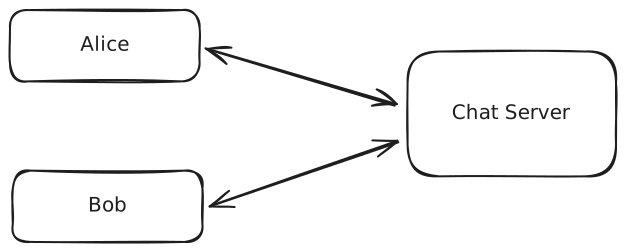
Single server chat app

ZooKeeper Basics

Data Model: ZNodes

Server Roles and Ensemble

Watches: Knowing When Things Change

Key Capabilities

ZooKeeper for Configuration Management

ZooKeeper for Service Discovery

ZooKeeper for Leader Election

ZooKeeper for Distributed Locks

How ZooKeeper Works

Consensus with ZAB

Strong Consistency Guarantees

Read and Write Operations

Sessions and Connection Management

Storage Architecture

Handling Failures

ZooKeeper in the Modern World

Current Usage in Major Distributed Systems

Alternatives to Consider

Limitations

So when should you use ZooKeeper then?

Smart Routing

Certain Infrastructure Design Problems

Durable Distributed Locks

Summary

References

Purchase Premium to Keep Reading

Unlock this article and so much more with Hello Interview Premium
Buy Premium

Currently up to 20% off

Hello Interview Premium

System Design Guided Practice
Exclusive content
Recent interview questions
Learn More
Reading Progress

On This Page

A Motivating Example

ZooKeeper Basics

Data Model: ZNodes

Server Roles and Ensemble

Watches: Knowing When Things Change

Key Capabilities

ZooKeeper for Configuration Management

ZooKeeper for Service Discovery

ZooKeeper for Leader Election

ZooKeeper for Distributed Locks

How ZooKeeper Works

Consensus with ZAB

Strong Consistency Guarantees

Read and Write Operations

Sessions and Connection Management

Storage Architecture

Handling Failures

ZooKeeper in the Modern World

Current Usage in Major Distributed Systems

Alternatives to Consider

Limitations

So when should you use ZooKeeper then?

Summary

References

Questions
Meta SWE Interview QuestionsAmazon SWE Interview QuestionsGoogle SWE Interview QuestionsOpenAI SWE Interview QuestionsEngineering Manager (EM) Interview Questions
Learn
Learn System DesignLearn DSALearn BehavioralLearn ML System DesignLearn Low Level DesignGuided Practice
Links
FAQPricingGift PremiumHello Interview Premium
Legal
Terms and ConditionsPrivacy PolicySecurity
Contact
About UsProduct Support

7511 Greenwood Ave North Unit #4238 Seattle WA 98103


© 2026 Optick Labs Inc. All rights reserved.